

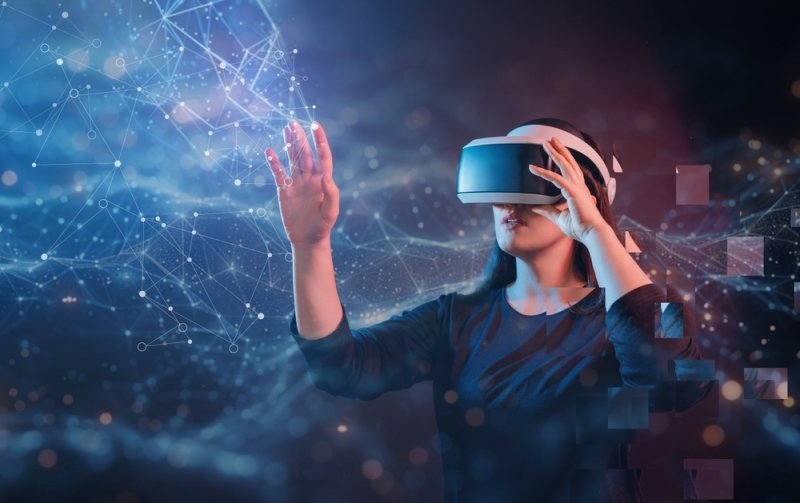
Similar to the process of placing computer graphics, sounds, and video atop and among computers and the information systems in use, Augmented Reality merges technology and the world, unlike some technologies that replace the user’s view of the real world with a view from the digital world.
Basically, it’s technology that superimposes a computer-generated image and audio over what the user is seeing when using augmented reality gadgets such as smartphones or tablets for better shopping, navigation, education, and entertainment experiences.
Through its gadgets, AR can use special sensors, cameras, and software, along with information from existing systems, for better visualization, such as smart software and navigation GPS with enhanced performance.
For example, imagine buying furniture with AR. The app on your smartphone shows a real photo of your living room and then displays the furniture you want to buy, from an actual sofa to an entire coffee set, to see how it might look in the actual space.
In order to deliver the AR experience, the AR app captures live feeds from your camera, processes the images, identifies the space using advanced software, and finally overlays the digital elements. It does this through the device’s cameras, sensors, computer vision algorithms, navigation, GPS, and accelerometer, which interpret features in your room in real time.
AR can use multiple technologies: augmented vision for processing visuals of the world, real-time imaging of what’s being scanned, and the creation of synthetic data, which includes information overlays that get layered into what’s currently perceived.
Explore More: AI vs Machine Learning: Differences, Uses & Examples

We already see many augmented reality examples. Navigation apps, for instance, help drivers to visualize roads, turns, and relevant points of interest directly overlaid onto a live view of their environment.
The retail world now showcases AR shopping apps and technology to offer a better and improved shopping experience where potential buyers can envision furnishings within their own homes before making an online purchase, or virtual try-on apps offer virtual testing of an apparel item on their body using AR.
Mobile apps and mobile games also embrace AR with the use of filters or gameplay elements incorporated into your immediate surroundings.
AR can broadly be categorized into two basic types: The ‘marker-based AR’, which requires any kind of specific visual marker such as a logo, symbol, or image. As soon as the mobile app or gadget recognizes this marked point, it immediately projects data, video, or any digital representation over the marker.
This technology has an advantage in terms of accuracy of placement, and in the packaging and education sectors, applications are most popular.
On the other hand, 'markerless augmented reality' does not need any trigger such as a marker; it is powered through the device’s sensors and computer vision. The system analyses the room or environment to accurately project and place digital content.
Augmented Reality applications go well beyond basic entertainment and gaming. Businesses leverage AR when they need to blend digital data with an individual’s interactions with a physical setting. They are useful across almost all business sectors, including:
The above examples show that augmented reality applications can assist in multiple fields where close detail, context, and relevance are needed when training or guiding someone on how to perform an activity.
The primary distinction between the two technologies is how much they involve the user with the physical world. AR augments; it does not replace our current reality. The environment in which a person is standing is real, and a digital augmentation is laid on top of it.
AR vs VR:
AR might be beneficial when an individual needs contextual information while still being anchored in their physical environment, for instance, in terms of giving directions in a physical world or demonstrating a task to be done on-site, while virtual reality excels for simulated training environments.
AR creates a better understanding of an object or a scenario by blending the real-world visual field with digital enhancements. There are several practical benefits of applying AR; it makes it easier to understand something.
It is useful for making virtual product displays that allow customers to feel as if they already own the item. It offers practical instructions and provides enhanced learning experiences to users.
AR can greatly contribute to providing direction. The limitations of AR are that it relies heavily on capable hardware, real-time processing power, and accurate software for delivering seamless functionality, which can also include a requirement for devices such as a camera or sensors.
AR, while currently used extensively in entertainment or basic AR camera filters, holds vast potential for the future in many fields such as communication, education, navigation, and productivity, particularly with innovations in wearable technology, computer vision, and artificial intelligence being developed every day. Augmented reality can contribute by giving much information that can be quickly visualized, and easier to comprehend and use.
It will give way for smarter applications with the aim of providing answers for real issues: whether people need help navigating, completing a task, visualizing a product for buying, learning how to operate new technology, or exploring an unseen environment.
Learn More: Mastering AI Prompt Engineering For Scientific Breakthroughs
AR enhances our perception and interaction with the real world by overlaying digital data. Its growing applications in fields like education, retail, manufacturing, and navigation, along with the contrast with virtual reality, highlight its significant potential for innovation.
As technology continues to mature, we'll likely see a far greater role for AR within our day-to-day routines.
Yes, many types of AR can work on a smartphone. Smartphones use cameras and other features, along with software that's designed to understand your environment, in order to display virtual objects. Users don't necessarily have to invest in special AR glasses for beneficial augmented reality functions to be put to use.
AR can also function in learning and educational settings by presenting virtual objects, or other forms of visual data, within the user's physical surroundings. It could be beneficial for teaching concepts or subjects where experiencing things in person is beneficial as opposed to solely reading about them.
No, not necessarily. AR features can function using their own hardware resources and information on devices. However, AR apps that utilize the internet for their own digital models, processed calculations in the cloud, real-time information updates, account dependent features may require a connection.
Some technologies could function with alternative sensors and equipment; however, camera devices were considered essential because they facilitate the understanding of the users' physical surroundings. Requirements vary among applications and the machines in use.
Probably not; all the technologies would serve different uses, which wouldn't compete with one another. Augmented Reality involves still interacting with our current real world, whereas virtual reality involves deep immersion. Therefore, it is expected that these two technologies will exist hand-in-hand. They are applicable to several professions as well as entertainment and learning purposes.
This content was created by AI