

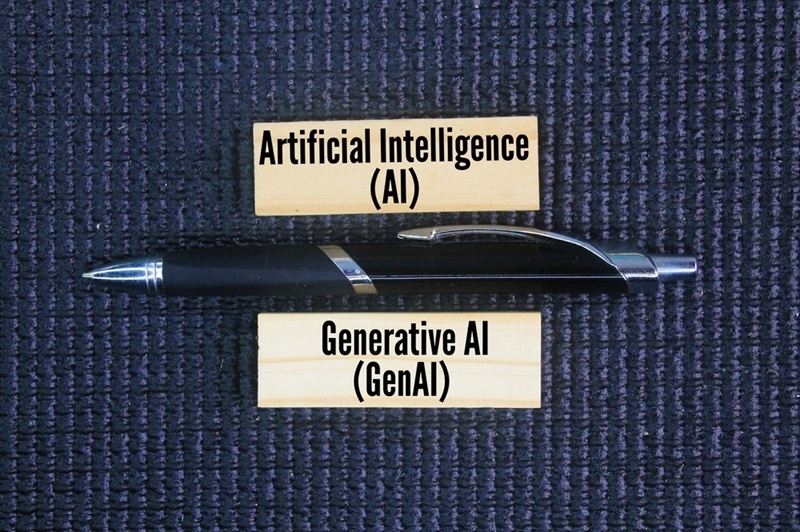
AI gets talked about like it is one giant thing. One box. One technology. But that is where a lot of the confusion starts.
In reality, AI includes different systems built for different jobs. Some are designed to recognize patterns, classify data, or make predictions. Others can generate text, images, code, audio, or other new outputs from prompts. That difference matters more than people think. It affects how companies use AI, what results they expect, and where the risks or limitations show up. Generative AI creates new content in response to prompts, while traditional predictive AI is more focused on tasks like classification, forecasting, and decision support.
The easiest way to understand generative AI vs traditional AI is this: traditional AI usually analyzes, predicts, or classifies, while generative AI creates. That is the cleanest distinction.
Traditional AI systems are often built to answer structured questions. Will this customer churn? Is this transaction fraudulent? What category does this image belong to? Generative AI, on the other hand, is designed to produce new output such as written responses, images, code, or audio based on patterns learned from very large datasets. IBM, Google Cloud, and Microsoft all describe generative AI as a system that creates original content, while traditional or predictive AI is more associated with forecasting, segmentation, or classification tasks.
That does not mean one is “better” than the other. It means they solve different problems.
Traditional AI has been around in practical business use for much longer. A lot of the AI people were already using before the current generative boom falls into this category. Think fraud detection, recommendation engines, demand forecasting, spam filters, search ranking, and customer scoring. IBM notes that earlier AI applications were largely built on traditional machine learning models, and Google Cloud describes traditional predictive AI as useful for forecasting risks, identifying segments, and making focused predictions.
A few common traditional AI uses include:
These systems work well when the goal is narrow and measurable. They are trained for a defined task and usually perform best when the rules, labels, or outcomes are clear.
This is also where types of AI systems start to matter. Not every AI model is meant to chat, generate content, or handle open-ended prompts. Many are built for one focused task and do that job extremely well.
Generative AI works in a more open-ended way. Instead of only sorting or predicting, it can produce something new. That might be a paragraph, an image, a summary, a code snippet, or a product description. Microsoft describes generative AI as using deep learning to create new content from natural language prompts, while IBM describes it as AI that can create original text, images, video, audio, or code.
That ability is why generative AI feels so different to everyday users. It is more visible. More interactive. More conversational. A person can ask it to draft an email, explain a concept, generate an image, or rewrite a proposal, and it responds directly.
Some common generative AI uses include:
This is where AI technology basics get easier to understand. Traditional AI often works behind the scenes. Generative AI is often right in front of the user, producing something they can read, hear, or see.
One of the biggest differences in generative AI vs traditional AI comes from how the models are trained.
IBM notes that generative AI is typically trained on very large datasets containing huge volumes of sample content, while predictive AI can often work from smaller, more targeted datasets built for a specific task. Microsoft also explains that generative AI relies on deep learning, which is a sophisticated form of machine learning designed to handle complex tasks and large datasets.
That means traditional AI often learns from structured, labeled data tied to a defined outcome. Generative AI often learns patterns across much broader and less narrowly structured content.
This is also why AI models comparison can get tricky. A traditional fraud model and a generative text model are not just different in output. They differ in scale, training style, and the kind of interaction they support.
You May Also Like: Are Multimodal AI Models the Future of AI Technology?
People still mix these up all the time. Understandable, but still wrong.
Machine learning is a subfield under AI. Deep learning is a more specialized part of machine learning that uses layered neural networks and is especially useful for complex tasks involving large datasets. Google Cloud describes AI as the broader umbrella, with machine learning underneath it, and Microsoft explains that generative AI uses deep learning specifically.
So when people discuss machine learning vs deep learning, the simple version is:
That matters because many traditional AI systems use machine learning, but generative AI is especially associated with deep learning and foundation-model-style architectures. Microsoft Research explains that foundation models are trained on massive amounts of data and can perform a wide range of tasks.
This is where people want a dramatic answer, but the honest one is less exciting. It depends on the use case.
Traditional AI is often better when the task is narrow, measurable, and repeatable. If a company wants to predict demand, score leads, or identify risky transactions, traditional AI may be the better fit. Google Cloud explicitly frames traditional AI as useful for risk forecasting and segmentation, while generative AI can help create new content or simulate scenarios around those outputs.
Generative AI is usually stronger when the task involves creation, interaction, or flexible language-based output. It shines when users need help drafting, summarizing, brainstorming, or transforming information into new formats.
A lot of companies will end up using both.
This is why discussions about types of AI systems should not turn into a winner-takes-all debate. Different tools. Different jobs.
A lot of confusion comes from the fact that both systems can appear to “predict” something. Technically, that is true. But the result is different.
Traditional AI predicts labels, categories, scores, or likely outcomes. Generative AI predicts the next likely token, pattern, or element in a way that allows it to generate a full output. IBM notes that both involve prediction at some level, but generative AI produces novel content while predictive AI forecasts future events or outcomes.
That difference changes how people should evaluate them.
With traditional AI, evaluation often focuses on accuracy, precision, recall, or prediction quality. With generative systems, evaluation can also involve usefulness, coherence, relevance, style, and safety. That is one reason AI models comparisonin the generative era feels less straightforward than older ML evaluation.
On a Similar Note: S-Corp Election Secrets Every Business Owner Should Know
There is a temptation right now to treat generative AI as the whole future of AI. That is too narrow. Generative AI is a major advancement, yes, but it does not replace every earlier AI method. Google Cloud explicitly says generative and traditional AI should support business goals and should not exist in isolation.
That is probably the most practical takeaway.
Traditional AI will keep handling focused prediction and decision-support tasks. Generative AI will keep expanding creative, conversational, and content-driven workflows. Together, they cover more ground than either one can alone.
So when someone asks about generative AI vs traditional AI, the smart answer is not to pick a side. It is to understand the job each one is built to do.
Yes, and that is often the smartest setup. A company might use traditional AI to segment customers, predict demand, or flag risky transactions, then use generative AI to create campaign copy, summaries, explanations, or support responses based on those results. In practice, many business workflows benefit from both structured prediction and flexible content generation rather than only one model style.
Not in a simple all-purpose way. It is more advanced for certain content-generation and language-heavy tasks, but that does not automatically make it better for all AI work. Traditional AI can still be more efficient, more accurate, and easier to evaluate for narrow prediction tasks. “Advanced” depends on what the business or user actually needs the system to do.
Because generative models are built to produce fluent, plausible output based on learned patterns, not to guarantee truth in every sentence. That fluency can make mistakes sound polished. Traditional AI systems can also fail, of course, but generative AI’s open-ended style makes its errors feel more human-like and sometimes more convincing. That is why review, grounding, and human judgment still matter.
This content was created by AI